Going Hypersonic!
ISP Launches New 40 mm Impact System
Expanding High‑Pressure, High‑Temperature Impact Research at WSU
The Institute for Shock Physics (ISP) recently commissioned a new single-stage, 40 mm-bore impact system that can obliquely impact materials up to 2.5 km/s – an exciting advancement in ISP’s ability to explore matter at extreme conditions including hypersonic conditions, continuing its 65‑plus‑year legacy of leadership in dynamic compression science.
ISP Professor and project Co-PI, Vikas Prakash, led the effort for this new capability, which enables researchers to study how materials behave at high pressures approaching 100 GPa with materials heated, prior to impact, to temperatures up to 2200 °C using resistive and inductive heating technologies. The new capabilities specifically enable the following:
- Advanced oblique plate impact experiments for combined compression-and-shear studies of material behavior at pressures up to ~100 GPa at elevated temperatures.
- High-temperature plate-impact experiments for conducting fundamental studies related to shock-compression of materials, including structural ceramics, at temperatures up to 2200 °C.
- Multiplexed, multi‑point, laser‑based velocimetry system (Photonic Doppler Velocimetry, or PDV) which, coupled with ISP’s established shock‑wave diagnostics, provides time‑resolved measurements of wave propagation on the billionth‑of‑a‑second timescale.
*This new capability was made possible through an Army Research Laboratory award via the National Center of Manufacturing Sciences. The WSU Principal Investigator for this collaborative and multidisciplinary project is Scott Beckman of the School of Mechanical and Materials Engineering. ISP provided funding to support required facility modifications and impact engineering support staff to install and commission the system.
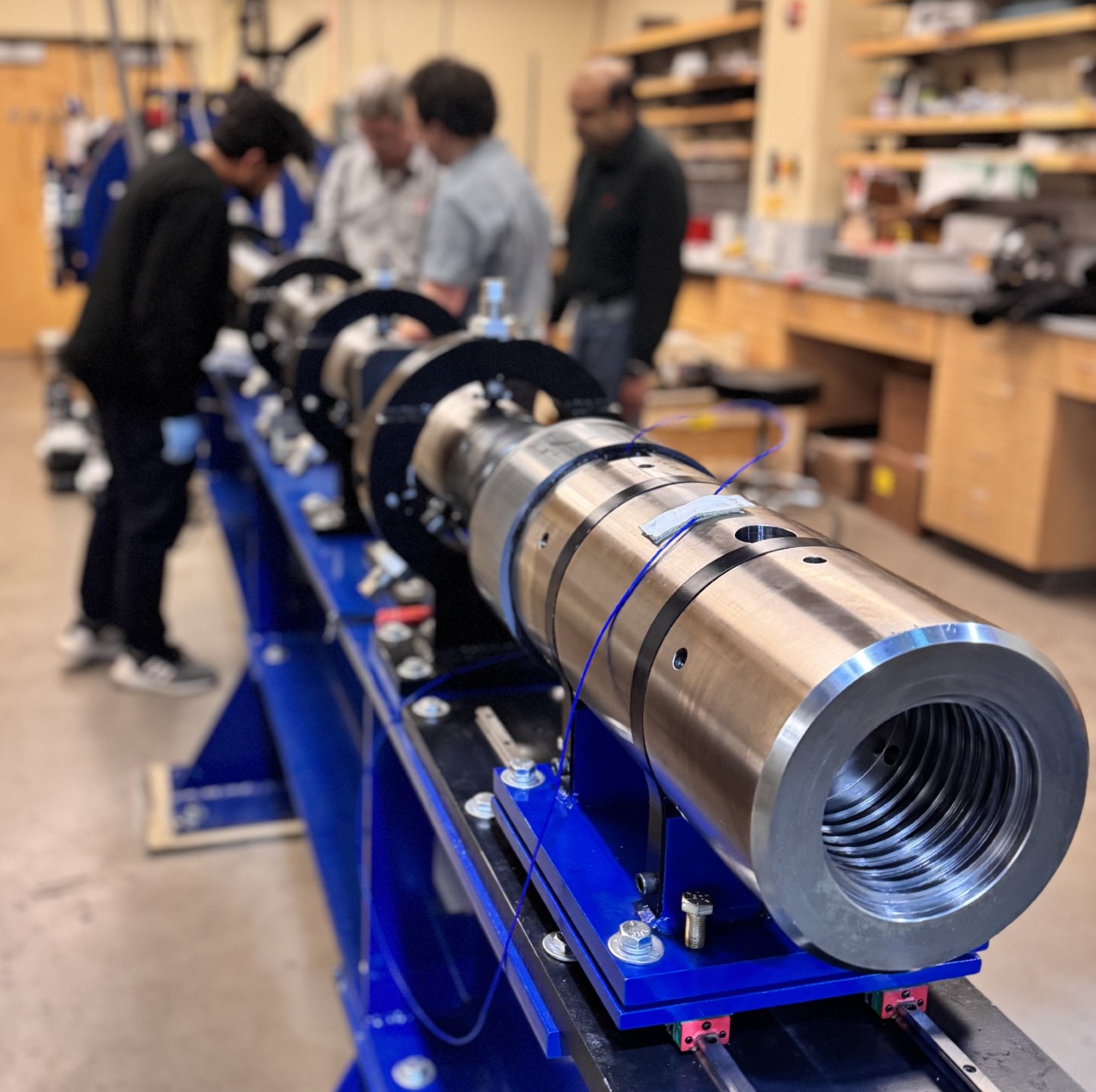
The 40mm bore launch tube assembly contains an internal keyway groove (4mmx 2mm).