
Publications
Publications Highlights:
Quantitative Characterization of Gradient Microstructures: A Study on Friction Stir Spot Processing of Pure Cobalt
Heterogeneous microstructures in polycrystalline metals can enhance the strength and ductility, outperforming homogeneous structures of similar composition. This study investigates deformed cobalt via friction stir spot processing with varying dwell times to uncover the effects of plastic deformation and heat generation on the formation of morphological, phase, and grain boundary character gradients. A new approach to quantify the morphological gradients in materials, which describes grain morphology in terms of density followed by parametric regression, enables direct quantification of processing depth and gradient sharpness. Results show that longer processing times increase the steepness of morphological gradients and reduce the deformation depth for friction stir spot processing with low plunge depths and high tool rotational speeds. The amount of retained FCC is increased in the shorter processing conditions, primarily due to refined grain size, increased defect content, and reduced heat generation. Crystallographic texture analysis of the HCP phase indicated a dominant B-fiber described by shear plane normal in the extreme processing conditions and the formation of a P-fiber, for intermediate dwell times. The texture of the FCC phase for low processing times was a C texture where longer processing times were dominated by a [001] fiber texture with a main orientation and emergence of a slight [111] fiber in the longest processing condition. The approaches outlined in this work give insight into quantifying gradients and improve the understanding of highly deformed cobalt.
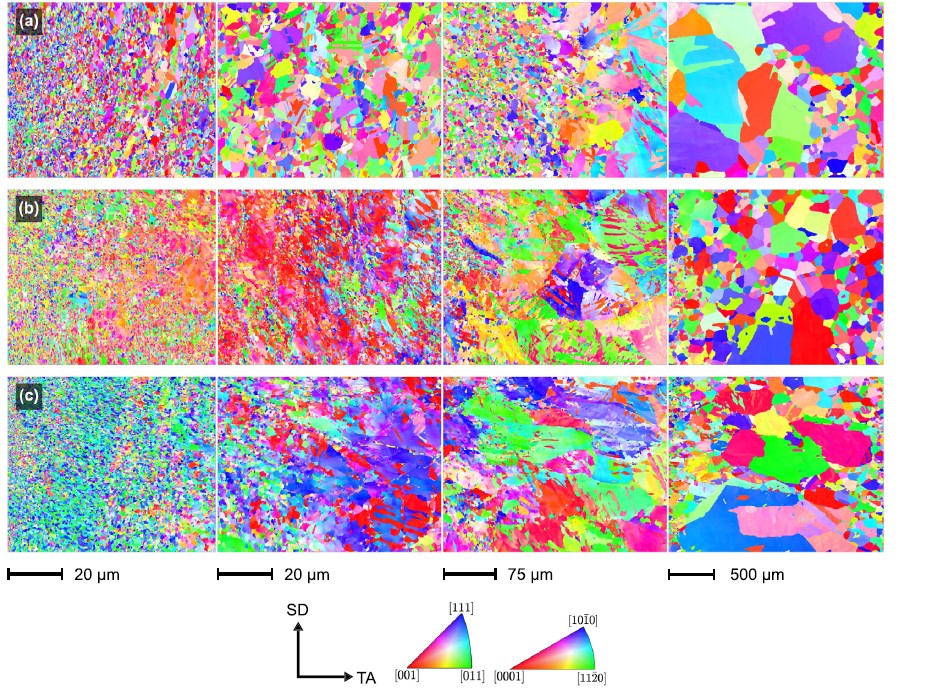
Interrupted EBSD orientation maps of FSSP-processed cobalt cross-sections, revealing morphological gradients. The leftmost image is the processing surface: (a) 2 s dwell processing condition; (b) 20 s dwell processing condition; (c) 40 s dwell processing condition. Scale bars are for each column of data.
Inelastic Deformation of Diamond Single Crystals Shock Compressed to Multimegabar Stresses: Wave Profile Calculations
As the archetypal strong solid, the response of diamond shock compressed to multimegabar stresses is important for fundamental science and for numerical simulations of wave profiles for applications in high energy density physics experiments. Previous experiments and analysis [Winey et al., Phys. Rev. B 101, 184105 (2020)] have shown that the commonly used hydrodynamic assumption is invalid for diamond shock compressed to stresses below melt and an elastic–inelastic description is needed. Here, we present a phenomenological material model for calculating wave profiles in shock compressed diamond single crystals that incorporates this description. Also, to support the modeling effort, we carried out wave profile measurements on shock compressed diamond single crystals at the Sandia Z facility to augment previous measurements. Wave profiles for [100] and [111] diamond calculated using the material model provide a good match to the elastic–inelastic response (observed two-wave structure) measured at ∼325 and ∼360 GPa. Furthermore, the calculated peak stresses for single (overdriven) waves provide a good match to the measured Hugoniot states for stresses reaching ∼700 GPa, which is near melting conditions. The present results show that the diamond single crystal response at multimegabar shock stresses is characteristic of a brittle solid—pressure-dependent strength and strength loss due to inelastic deformation.
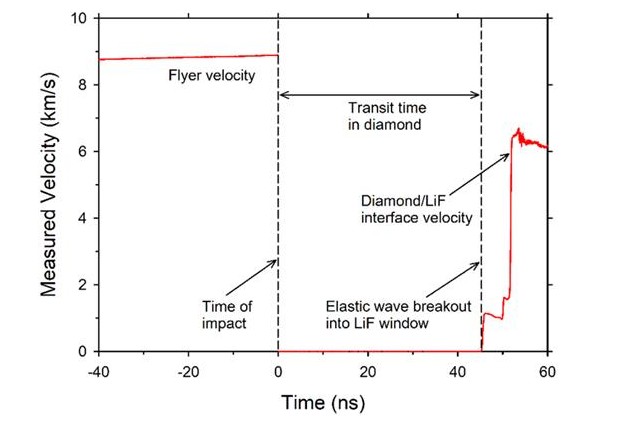
Representative results for plate impact experiments at the Sandia Z facility on diamond single crystals backed by a LiF window. Laser interferometry results from experiment Z3435—N7 show the flyer velocity up until impact, loss of signal upon impact with the diamond sample, and arrival of the shock wave at the diamond/LiF interface. The measured diamond/LiF interface velocity indicates a two-wave structured shock.
Melting Anisotropy in Crystalline Solids
Despite the long and extensive history of melting studies, experiments to determine the dependence of melting on crystal orientation are lacking. Using longitudinal sound speed measurements in aluminum single crystals shock compressed along ⟨100⟩ and ⟨110⟩ to 168 GPa, we address this need and show that the melting transition (both onset and completion) is strongly anisotropic. The present findings demonstrate the need to consider the role of deformation induced lattice defects on the melting transition and provide a general approach to examine melting anisotropy in crystalline solids.
Shock-Induced Melting of [100] Lithium Fluoride: Sound Speed and Hugoniot Measurements to 230 GPa
Although [100] lithium flouride (LiF) is the most widely used optical window material in dynamic compression experiments, its high stress (>100GPa) shock compression response, including melting, is not well understood. To address this need, we measured wave profiles in plate impact experiments to determine the Hugoniot states and longitudinal sound speeds in [100] LiF crystals shock compressed to 231 GPa. The measured peak states are fitted well by a linear shock velocity–particle velocity relation, providing an accurate determination of the LiF Hugoniot curve to significantly higher stresses than previous experiments. The longitudinal sound speeds show a near linear increase with density compression to 182 GPa. Between 182 GPa and 195 GPa, the sound speed and the longitudinal modulus decrease abruptly, due to shock-induced melting. The increasing sound speeds and moduli at higher stresses suggest that shock compressed LiF is fully liquid at 195 GPa and above, allowing determination of the Grüneisen parameter for liquid LiF. The melt stress determined here differs from that predicted by current multiphase equations of state for LiF. Our results provide important insight into the high stress solid and liquid states of shock compressed LiF and point to the need for an improved multiphase equation of state at high pressures and high temperatures.
Observations of Twinning Microstructure in Iron Ramp-Compressed Through the 𝛼−𝜀 Phase Transition
Single crystal iron was ramp-compressed along the [100] axis at 4 GPa/ns through the α−ε phase transformation at 13 GPa. Unlike shock experiments, in these ramp compression experiments the bcc lattice is observed to be nearly isotropically relaxed before the phase transition. There was a mixed α/ε phase region starting at ∼13 GPa, which was observed for 0.75 ns until the peak stress of 18 GPa was reached. In situ x-ray diffraction measurements show the formation of new hcp orientations not reported in shock or quasistatic compression experiments. The new hcp orientations appear to be caused by {10¯11}⟨10¯1¯2⟩→{¯1011}⟨¯101¯2⟩ sequential twins that occur during the phase transition. This twinning mechanism relieves the shear strain caused by the bcc-hcp phase transition from the isotropically relaxed bcc phase while subject to uniaxial compression. These results show that in iron the induced microstructure through a phase transition and the phase transition mechanism depend on the loading history.
Near-Optimal Combination of High Performance and Insensitivity in a Shock Compressed High Explosive Single Crystal
Achieving the desired combination of superior detonation performance and insensitivity to shock initiation has been a long-standing goal in high explosive (HE) science and technology. Having previously established the shock insensitivity of 1,1-diamino-2,2-dinitroethene (also known as DADNE or FOX-7) single crystals to 20 GPa (extended to 25 GPa in this work), the FOX-7 detonation response was determined through wave profile measurements in ∼250 μm thick single crystals shock compressed to 64 GPa. Quite unexpectedly, FOX-7 demonstrated the classic Chapman–Jouguet (C–J) detonation response—reaction completion in the detonation front (<0.7 ns) at pressures of 44 GPa and higher—not observed in other insensitive high explosives. The experimentally determined C–J pressure (35 GPa), detonation wave velocities and the detonation products equation of state—together with shock insensitivity to 25 GPa—demonstrate that FOX-7 single crystals display a near-optimal combination of high performance and shock insensitivity, not observed in another HE crystal.
To read the Editor’s Pick publication in the Journal of Applied Physics, please click on the heading above.

The FOX-7 molecule (a) and the direction of shock compression in FOX-7 single crystals (b). The crystal structure shown is a projection onto the bc plane, where b is the twofold rotation axis of the monoclinic unit cell. Atoms are indicated by the following colors: carbon—gray; nitrogen—blue; oxygen—red; and hydrogen—white. Crystal unit cells are indicated by white lines.
Role of Graphite Crystal Structure on the Shock-Induced Formation of Cubic and Hexagonal Diamond
Since cubic diamond was first recovered from explosively shocked graphite samples in 1961, the shock-induced graphite to diamond phase transformation has been of great scientific and technological interest. In a recent issue of Physical Review B, Washington State University researchers show that during shock wave compression at about 500,000 atm of pressure and of about 100 nanoseconds duration, graphite is transformed into either hexagonal diamond or cubic diamond, depending on the crystal structure of the graphite crystallites that make up the sample.
To read the Editors’ Suggestion publication in Physical Review B, please click the article title above.

The figure shows x-ray diffraction data for two types of graphite: (a) and (b) show data for graphite crystallites having hexagonal structure, while (c) and (d) show data for graphite crystallites having turbostratic structure.
Hugoniot States and Optical Response of Soda Lime Glass Shock Compressed to 120 GPa
In contrast to relatively pure silica glass (fused silica—FS), commercial silica-rich glasses contain significant fractions of additional oxide components. In particular, soda-lime glass (SLG) consists of approximately 71% SiO2 by weight, which raises the question: what is the effect of additional cations on the shock compression response of silica-rich glasses? To address this question, Washington State University researchers conducted plate impact experiments were conducted to determine the high-pressure Hugoniot states for shocked SLG (37 to 120 GPa) and compared with recently reported results on FS.
To read the Editor’s Pick publication in the Journal of Applied Physics, please click the article title above.

Experimental configuration used for transmission wave profile measurements under planar impact loading. Both VISAR (532 nm, green arrows) and PDV (1550 nm, red arrows) were used to obtain wave profiles at the sample–window interface, while PDV (1550 nm) was used to obtain the impact time for tilt and shock speed measurements.
Synchrotron x-rays reveal atomistic-level deformation mechanisms in gold shock compressed to megabar stresses
Shock wave compression is uniquely suited to examine extreme thermodynamic states in solids on nanosecond timescales. Most often, shock compression at high stresses (~1 Mbar) is viewed as a superposition of pressure and temperature, and deformation effects – particularly, at the atomistic level – have not been examined due to experimental challenges. Although molecular dynamics simulations have long suggested the generation of stacking faults (SFs) – a particular type of lattice defect related to partial dislocations – in shock compressed face-centered-cubic (fcc) metals, direct observations of SFs have been lacking. Using laser-shock experiments at the Dynamic Compression Sector (APS, Argonne), in-situ x-ray diffraction (XRD) measurements provided observations of SFs on sub-nanosecond timescales in shock compressed gold. SFs – ABCBCABC stacking of {111} planes instead of the normal ABCABC stacking – are a consequence of the uniaxial strain state achieved under shock compression and provide direct insight into deformation mechanisms. Detailed XRD simulations, incorporating SFs, fitted to the measured XRD data showed that SF abundance increased monotonically with increasing compression; at 1.5 Mbar stress, almost every sixth atomic layer was a SF. These findings, for the first time, provide a quantitative understanding of the deformation state at the atomistic level in a shock-compressed fcc metal.

Real time nanosecond x-ray diffraction measurements in shock compressed gold reveal abundant generation of stacking faults at megabar shock stresses.
Recrystallization of shock-melted Si observed in real-time
By Kendra Redmond; October 29, 2018
Washington State University researchers have directly observed shock-induced melting and recrystallization of silicon on nanosecond timescales. As they report in a recent issue of Physical Review Letters, the researchers observed the melting through in situ, time-resolved x-ray diffraction (XRD) measurements at pressures above 30 GPa. This work adds new constraints to the high-temperature, high-pressure phase diagram of silicon and suggests that the technique could similarly reveal structural changes in other materials under shock-wave compression.
“Melting and freezing are two of the most ubiquitous materials phenomena,” says Yogendra Gupta, senior researcher on the project. “Typically, these phenomena are viewed as slow—because our familiarity with these phenomena is mostly based on observations at long time scales. Hence, some questions that have been around for a long time are: How fast can these phenomena occur? And what is the nature of the material state?” These are fundamental questions, Gupta says, but the answers also have applications in ballistics, debris-spacecraft collisions, and planetary formation, among other areas.
To read the entire Materials Research Society story, click the above heading.
Read the abstract in Physical Review Letters.

Representative x-ray diffraction patterns recorded from shocked Si (100) (a) before and (b) after melting. The times listed in (a) and (b) are relative to impact. Credit: Physical Review Letters 121(13): 135701 (2018).
Institute for Shock Physics Publications in the News:
- Scientists Create Crystal Stronger Than Diamond (Forbes – March 31, 2021)
- Meteorite Strikes May Create Unexpected Form of Silica (Carnegie Science News – August 26, 2020)
- Recrystallization of Shock-Melted Si Observed in Real-Time (MRS Bulletin – October 29, 2018)
- Findings Show Nanostructures Can Withstand High Levels of Strain While Keeping Photoluminescence (AIP Scilight – August 13, 2018)
- Watching How Rare, Meteoric Diamonds Form (Scientific American – December 25, 2017)
- Transformation of Graphite into Hexagonal Diamond Documented by WSU Researchers (WSU Insider – November 3, 2017)
- “Watching” Crystal Structure Change in Real Time (Advanced Photon Source Science Highlight – July 29, 2016)
- Researchers Create Superconductor from Solvent (WSU Insider – July 1, 2013)
- Diamond Loses its Stiffness Crown to New Material (NewScientist – February 2, 2007)
These links lead to external websites that are not hosted by the university. The views and content expressed do not represent the official positions of the university.